

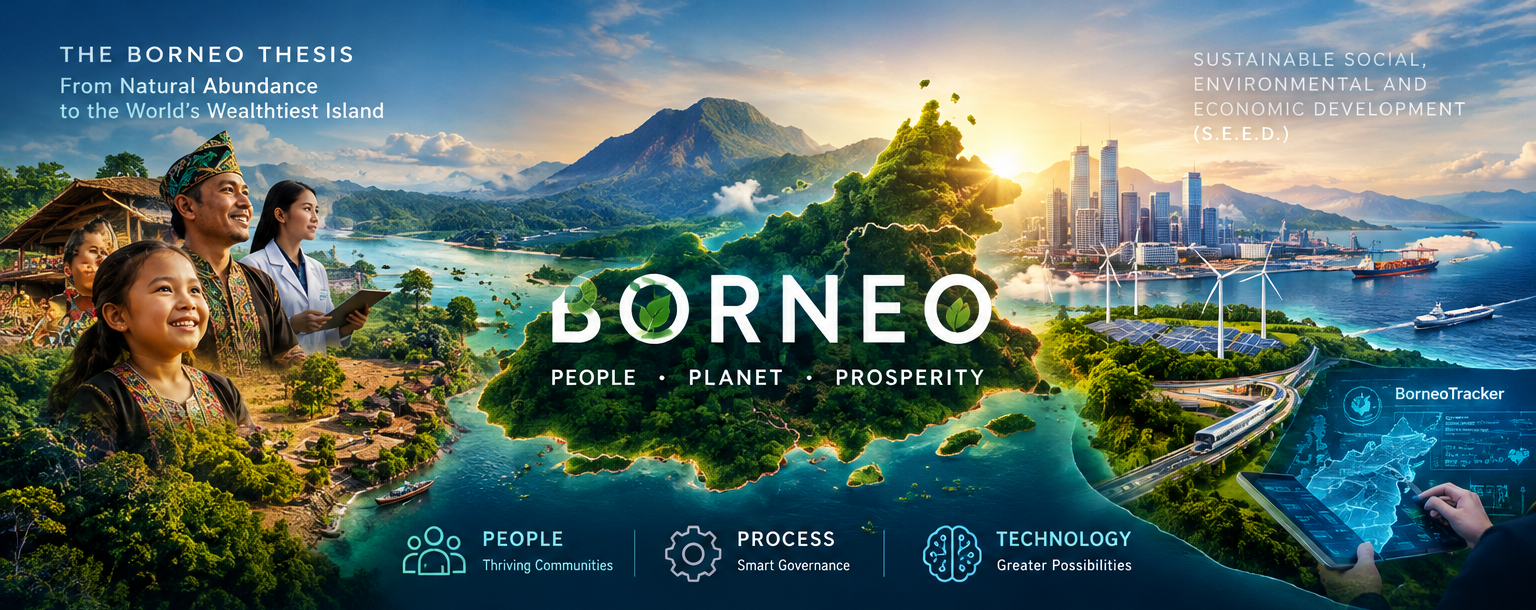
From Natural Abundance to the World’s Wealthiest Island
一生二,二生三,三生万象。
From One, Two emerges; from Two, Three unfolds; from Three, all things arise.
This ancient Chinese philosophy offers a powerful way to understand the future of Borneo. Great transformations do not begin with isolated projects. They begin with a unifying idea, evolve into complementary frameworks, and ultimately become systems capable of creating value at scale.
For Borneo, that idea is a bold but purposeful ambition: to become the world’s wealthiest island—not merely in financial terms, but in the totality of human wellbeing, environmental integrity and sustainable economic prosperity.
This is the Borneo Thesis.
From One Vision to Three Frameworks
The Borneo Thesis begins with a fundamental question: What if Borneo’s greatest opportunity is not to extract more from its natural resources, but to build a civilization that creates more value from everything it possesses?
Spanning the territories of Malaysia, Indonesia and Brunei, Borneo combines extraordinary natural assets, cultural diversity, strategic geographic significance and opportunities for development. Yet natural abundance alone does not guarantee prosperity. Resources can coexist with inequality, economic growth with ecological degradation, and foreign investment with limited local value creation.
The missing link is the system that connects resources to outcomes.
My work as a computer engineer, technology strategist and author has consistently explored how ideas, technology and systems can be connected to produce practical results. Three frameworks form the foundation of this vision:
- the ABCDE Framework,
- the True Wealth Hexagon and
- the Borneo Thesis.
The ABCDE Framework provides the technological architecture.
The True Wealth Hexagon defines what prosperity should deliver.
The Borneo Thesis identifies where these principles can be translated into a regional development model.
Together, they turn an aspiration into a strategic blueprint.
Technology and Humanity
The ABCDE Framework brings together five interconnected capabilities: Artificial Intelligence, Blockchain, Connectivity, Data and Ethics.
- Artificial Intelligence enables intelligent analysis and resource optimisation.
- Blockchain supports trust, traceability and transparent value flows.
- Connectivity links people, infrastructure and systems.
- Data transforms observations into knowledge.
- Ethics ensures that technological progress remains accountable to humanity.
But technology alone cannot build a resilient civilization.
The fundamental, essential dimension is humanity, expressed through People, Process and Technology.
- People establish purpose, contribute knowledge and create value.
- Processes translate intentions into repeatable, accountable action.
- Technology provides the tools to coordinate, automate and scale what works.
When these three elements operate together, digital transformation becomes more than the deployment of software. It becomes the redesign of how society creates, distributes and sustains wealth.
This is the foundation upon which Borneo can leapfrog conventional development models—not by abandoning what works elsewhere, but by applying proven knowledge and emerging technologies to build systems suited to its own people, geography and future.
Defining True Wealth
What should this system ultimately deliver?
The True Wealth Hexagon identifies six foundational dimensions: Food, Energy, Education, Shelter, Healthcare and Entertainment.
These are not merely economic sectors. They are essential components of a life worth living.
A wealthy Borneo must enable its communities to access nutritious food, reliable and sustainable energy, quality education, dignified housing, effective healthcare and meaningful cultural and creative experiences.
Gross domestic product, export figures and investment commitments remain important measures of economic activity. However, they cannot independently establish whether prosperity reaches households, strengthens communities or protects the ecosystems upon which future generations depend.
True wealth emerges when economic productivity translates into better lives, when natural capital is preserved rather than depleted, and when opportunities are distributed more equitably.
The goal is therefore not growth at any cost. It is the creation of a resilient economic system that continuously improves the six dimensions of human wellbeing.
S.E.E.D.: The Operating Principle
The pathway is Sustainable Social, Environmental and Economic Development (S.E.E.D.).
Like a seed, development must contain the conditions for future growth. Economic investment provides resources, social inclusion creates legitimacy, and environmental stewardship preserves the foundations upon which prosperity depends.
These dimensions must advance together.
Borneo can pursue renewable energy, sustainable agriculture, responsible tourism, advanced manufacturing, digital infrastructure, healthcare innovation, education and creative industries.
The strategic objective is to connect these sectors into mutually reinforcing ecosystems rather than develop them as isolated initiatives.
Local communities must participate not only as workers or recipients of assistance, but as entrepreneurs, suppliers, skilled professionals, asset owners and partners in value creation.
Indigenous knowledge, cultural heritage and community rights must be respected. Environmental safeguards must be built into project design. Skills development and technology transfer must help local businesses move up the value chain.
This is how investment can create enduring prosperity rather than temporary economic activity.
Impact-Driven FDI: Connecting Global Capital to Local Wealth
Foreign direct investment is a potential catalyst for this transformation.
However, the question is not simply how much investment Borneo can attract.
It is what each investment contributes, who benefits, and whether its value endures.
Impact-driven FDI should connect global capital with measurable local outcomes: quality employment, stronger local enterprises, technology transfer, infrastructure improvements, environmental performance and greater community participation in economic value creation.
Development finance institutions, including the Asian Development Bank and the World Bank, can be important partners through appropriate financing instruments, technical assistance, project preparation, risk mitigation and institutional capacity building. Their participation must be pursued through suitable programmes, eligibility requirements and project-specific assessments.
Private investors, domestic financial institutions, governments and local enterprises also have essential roles.
The opportunity is to develop a pipeline of credible, investment-ready projects supported by transparent evidence, sound governance and measurable development outcomes.
Capital must not merely enter Borneo.
It must:
- circulate through its economy (flow),
- strengthen local capabilities and
- generate lasting value.
BorneoTracker: Making Progress Visible
A vision becomes actionable when progress can be measured.
BorneoTracker can serve as the public dashboard for the Borneo Thesis: a common intelligence layer that brings together relevant geographic, economic, social and environmental indicators.
By connecting data across locations and development priorities, it could help communities understand local conditions, governments identify gaps, investors evaluate opportunities, and researchers monitor outcomes.
The dashboard should make both progress and shortcomings visible. Its indicators should have transparent methodologies, traceable sources, clear update dates and appropriate distinctions between verified data and estimates.
In doing so, BorneoTracker can help turn fragmented information into shared understanding—and shared understanding into better decisions.
Its ultimate value will not be the number of indicators displayed, but whether the information helps:
- mobilise better investment,
- improve public accountability and
- deliver measurable benefits to people.
The First Blueprint, the Larger Mission
The book ABCDE Framework in the True Wealth Hexagon is the first blueprint: a foundation for connecting technological capabilities with the essential dimensions of human prosperity.
The Borneo Thesis extends that blueprint into a regional development proposition. Borneo becomes the living environment in which technology, capital, institutions, communities and nature can be brought into a coherent system for sustainable development.
The ambition is not to declare Borneo wealthy before the evidence supports it.
It is to:
- define wealth more intelligently,
- build the systems required to create it, and
- measure whether its benefits reach the people and ecosystems that sustain it.
The world’s wealthiest island should not be the place with the most billionaires, tallest buildings or largest extraction revenues. It should be the place where human potential flourishes, essential needs are met, nature remains resilient, innovation creates shared value, and prosperity can endure across generations.
- One vision.
- Two complementary foundations—technology and humanity.
- Three interconnected frameworks.
Countless opportunities to create a better future.
Borneo to become the world’s wealthiest island. Not by taking the most from the world, but by creating the greatest enduring value for its people, its environment and humanity.
That is the Borneo Thesis. And the work begins by connecting the dots forward.